
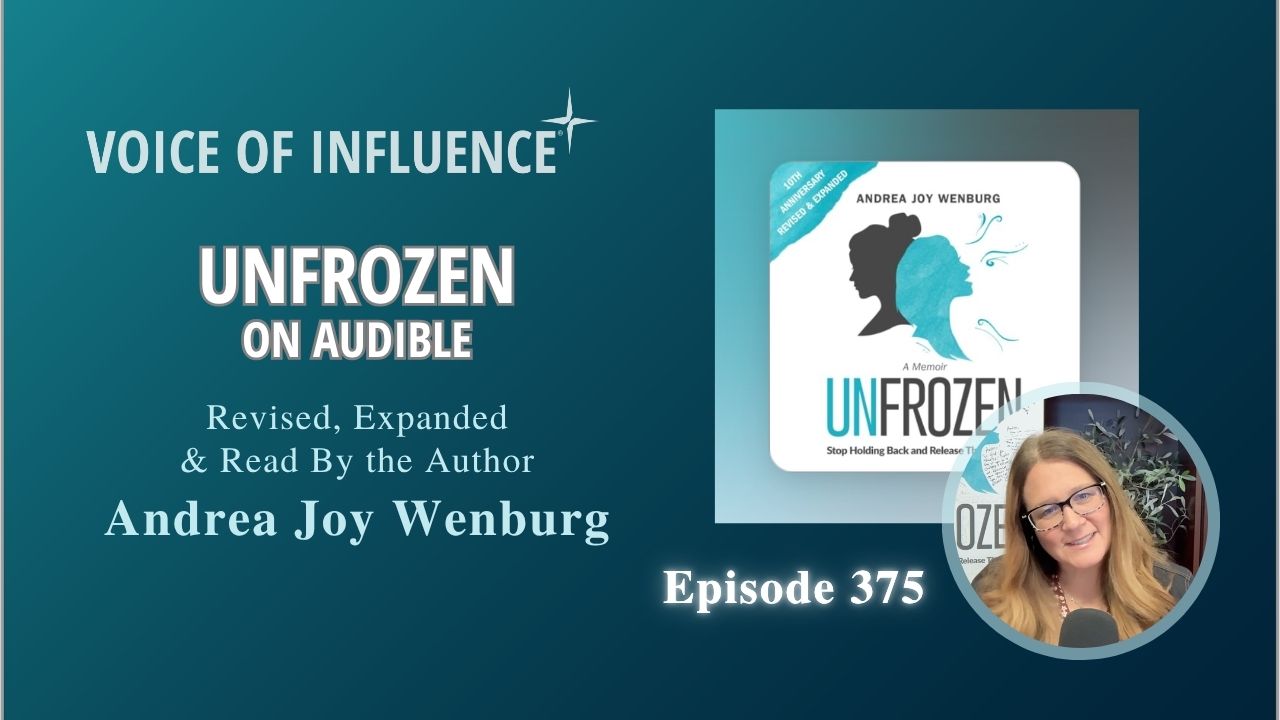
Unfrozen, Pt. 1
Andrea returns after a hiatus to share a personal summer story and reflect on the journey that led to the re-release of her book Unfrozen, now available as an audiobook.
Unfrozen is now available on Audible. Please leave a review if you’re able.
Audible Link: https://www.audible.com/pd/Unfrozen-Audiobook/B0HG85GVBG?source_code=ASSGB149080119000H&share_location=pdp
Amazon Link: https://tinyurl.com/yd3p2nyn
Timestamps:
0:00 — Welcome & The Summer Story
3:16 — The Walmart Incident
4:28 — The Kids’ Feedback
5:53 — “Let Us Help” — The Big Lesson
6:03 — The Caregiver’s Burden
8:49 — Who We’re Trying to Help
11:22 — Back to Unfrozen
12:42 — Writing the Book
14:35 — The Four-Part Story Arc
16:02 — Publishing & Moving On
17:26 — Going Corporate
20:00 — The Realization
21:37 — Sharing Influence
23:13 — Re-releasing Unfrozen
23:54 — The Audiobook
25:23 — Closing & Call to Action
Connect with Andrea:
Facebook | Instagram | TikTok | LinkedIn
Transcript:
Welcome & The Summer Story
Hey there, it’s Andrea, and welcome back to the Voice of Influence podcast. It has been a few months, but I’m back today with a little story, because I’m wondering if you can kind of relate to this situation. So do you ever feel like you are carrying and holding it all, and that that ends up making you a little more irritable than you would like?
Maybe you feel overwhelmed. Maybe you have these aspirations, these dreams, this belief that things can go right, and then something happens, and it just feels like it’s all out of whack. Well, that happened to me this summer. It was in the family context. So we were taking this trip to a nearby city, and we had a family friend with us.
We were going to visit family friends, so it was fairly complicated, this little trip that we were taking. And I have teenagers now, so we have a son who is [00:01:00] 17, Grant, and a daughter who’s 19, Amelia. I didn’t wanna waste their time, because their time is so precious right now. It’s precious for us to be able to spend any time with them, but also, like, they have, they have a lot going on, and I know how important it is for them to live their own lives and have their own friends.
And so I wanted to make sure that this trip would be valuable and worth it for everybody, our friends, our family, everybody. So, but I thought to myself, ” I don’t wanna be that, that girl, that mom that I can be sometimes, where I get so wrapped up in trying to make things go perfectly that I get irritable.
And when things don’t go my way, when things don’t go the way that I plan, that I end up becoming the problem, because I get irritable.” That’s the best way I can describe it. Um, and, and I started [00:02:00] off the trip great. We started out with just, you know, I was totally chill, just enjoying it, enjoying, enjoying the family, enjoying the friends, all that sort of thing.
And then something happened kind of in the middle where somebody was, like, a little off. Like, noth- things weren’t just going quite the way that they had planned or, or expected. And the thing is, is that I had tried to take into account everybody’s desires, everybody, what everybody wanted to achieve. But we got to this point and there was that little bit of disappointment and then I thought, “Oh no,” and I kind of got all wound up, became irritable, started feeling, probably feeling resentful about all the pressure that I was putting on myself and feeling that even though other people weren’t necessarily putting pressure on me, I felt like it was my responsibility to take care of everything and to make sure that everybody got what they needed out of [00:03:00] this, out of this vacation So it all kind of culminated in the last night when we were making this purchase at a Walmart, and I was super rude to the person at, to the cashier.
The Walmart Incident
And I just, it’s, so it was sort of like one of those moments where you’re like, I had just had enough, and I was so irrit- irritated with everything, and the fact that this person was kind of blaming us for the situation that we had and everything, I was just like over it. I was like, “Okay, you’re not helpful.
We’re out of here.” And It was, quite frankly, it was embarrassing. It was embarrassing because, I mean, it wasn’t that embarrassing. Like, I didn’t care that much. Let’s be real. I didn’t care that much, but it’s so not me to want to, like, make other people have a bad day or a bad night. Like, I have this T-shirt from a Jon Batiste [00:04:00] concert.
I don’t know if you’ve ever been. He’s amazing, by the way. We’ve been to a couple of his shows, and he’s so sweet, and his heart is so, so sweet. He has this T-shirt that says, “I love you even if I don’t know you.” And, like, that is kind of vintage Andrea. But, like, that night, if I would’ve been wearing that shirt it would’ve been ridiculous because it was very much like, ” If I don’t know you, I don’t care.”
The Kids’ Feedback
I mean, that’s essentially how it was coming off. And ultimately, the kids, when we got home, we got, we got done with everything. It was fine. Like, we ended it fine. But we got home, and both of my kids sat me down and said, “How do you think that went, Mom?” And I was like, “Um, well, obviously I got too wrapped up in things and I got irrit- irritable and blah, blah, blah.”
And they were like, “Yeah, that was dumb.” But also, they really felt like I’d [00:05:00] over-planned the whole thing, and that we didn’t have as much time to just visit and connect with these people, our friends, as they would’ve liked. So I had, and then it made me think about the fact that I, really what I’d done is I had tried to take on what everybody wanted, but I was making some assumptions about what everybody wanted.
I was assuming that my kids and our friends would want to do cool things in the city when maybe that was a little bit of a bonus, but what they really wanted to do was connect. And rather than just making space for that, I had over-planned it in order to try to, you know, I don’t know, just over-manage the situation.
“Let Us Help” — The Big Lesson
What they said to me next is probably one of my biggest lessons of the summer. They said, “Mom, next [00:06:00] time, let us help. Let us help plan.”
The Caregiver’s Burden
Oh. I mean, I don’t know about you, but if you’re somebody who’s a little bit like me, where you are constantly on, and I think, I think this probably relates a little bit more to women than men. I’m not saying no man ever experiences this. Maybe you do. B- but I know that women do. I know that there’s a lot of women who do.
And part of the reason or the person, let’s say the, the primary caregiver or the person who takes on that kind of a responsibility in their family’s life, they, they — when, when your kids are young, you’re thinking, ” I’m responsible for everything. I’m responsible for the fact that they’re crying right now.
What am I supposed to do about this?” And it can be a lot of pressure. It can be a heck of a lot of pressure. And you assume that even though the baby has no way of, like, [00:07:00] mentally processing, “Oh, this is my caregiver, and they are not giving me what I want all the time, and so I’m gonna cry.” They’re not thinking about that, but we are.
And yes, neglect can happen, and that can leave a very lasting impression on, on a person if that happens when they’re little. So I don’t mean to underplay that. But my point is that I went from, and I feel like I should own this for myself, and then if this applies at all to you, go ahead. Um, but I went from, I want to be this kind of person, this kind of mom, this kind of wife I want to take care of my baby and
I want my baby to have what they need to now I’ve got toddlers and little kids, and I know I need to do certain things to help them to grow up and, and for all of us to stay sane in the process. We have to get sleep, we [00:08:00] have to get, you know, well-nourished, and et cetera, et cetera. So there’s so much going on in my head when the kids were little, and then as they’re growing, there’s this sense of like, I still hold the whole thing together.
And then as they got into like high school and whatnot, and they started to have their own lives outside of their family, of course, I’m, you know, cognitively I can recognize, yeah, I need to take a step back. Like, these kids can figure some things out on their own, and I do, and I did. But there’s still those times when everybody’s together, you know, you’re on this trip and you’re with friends and whatnot, and you feel like you’re still the one that needs to make sure everything goes okay and that everybody gets what they need out of the situation.
Who We’re Trying to Help
It’s hard to know when to, like, set that aside and let other people be a part of the whole process, be a part of [00:09:00] making decisions, thinking through, giving their perspective, and so forth. And I think the reason why, the reason why I’m really honing in on this is that over the last, I’d say couple years, but especially over the last few months since I’ve been on the show, since we’ve had the Voice of Influence podcast kinda hiatus, I have been putting an enormous amount of time and energy in figuring out who we are really trying to help, that problem that we’re trying to solve so that it’s s- more simply explained, it’s easy for people to relate.
They know when it’s time for them to come to us for listening to the show or reading a book or whatever it might be. Making use of a resource, calling us to help with some program that they wanna achieve or a culture initiative.
[00:10:00] Ultimately, I came down to realizing that I wanna serve the person who is a mission-driven leader, who has lots of ambition, who actually, like, really could get a lot done and does get a lot done, has a team and believes in their team, believes in what they can do and what the mission can do, but often doesn’t even realize that they’re getting in their own way.
That they are, because they’re so capable, because they’re so creative, because they’re such good problem solvers, because they are so strategic, They have a hard time getting other people to relate to them and their situation. They have a hard time getting other people to take ownership the way that they do.
And sometimes they just get in their own way. And it’s not all their fault, don’t get me wrong. It’s not all their fault. But because I have lived this [00:11:00] life, because I have scrutinized all of my moves, because somebody like that some- often does that, um, that is the, the person I think that is going to most resonate with this show possibly with the things that I produce in the future, and even some things that I’ve produced in the past.
Back to Unfrozen
So that gets me back to Unfrozen, this book. Um, this poster. This is super fun. I… So I wrote Unfrozen. This was sort of my entry into this world back in 2016. In 2013, I went to the movie Frozen and was so moved by it, and I just was like, it was just this huge emotional, cathartic experience, and it continued to be for months and months and months.
And I wrote about it online. I started blogging in 2014. It took me a whole year to, like, get out [00:12:00] what I was trying to say. Like, what? It was just so intense inside of me, I couldn’t even, like, articulate why it was such a big deal. And then in, like, a whole year later, I finally wrote a blog post about, like, Frozen top 10, top 10 things that I noticed about Frozen, and it was like
turned out to be super simple. But what it did was that unleashed this, and sort of opened up my voice to be able to express more of what I had been experiencing and why this mattered because I’d been trying to figure out what in the world I was supposed to do with myself, and all this, like, the ideas and the thoughts and the experiences and the connections and all that.
Writing the Book
And so people were kind of watching me on this journey, and one of my friends said, “Andrea, you have got to write a book about this,” Debbie Dekleva. She said that to me. I actually interviewed her on this show, um, so you can go back and find it, but yeah, she, she said that to me. “You’ve got to write a book.”
And so I was like, “You know what? I really [00:13:00] want to.” But how? How do I even do that, and what am I trying to do? Well, I don’t wanna go through the whole process of explaining everything about it quite yet, but, and m- um, but, but basically, Unfrozen became my memoir and became stories about my life. And, um, one of the things that my son asked me recently was like, “Okay, so it’s like stories, but, like, what is the overarching arc?
What holds it all together?” It explores my own processing through, you know, trying to find my voice, trying to understand what it means to be a woman, and also to have some, like, really intense leadership qualities, um, then to realize that I really wasn’t going to be able to get anywhere with it on my own.
Like, I n- I felt like I really needed men to respect me. Even when I was little, like, boys laughing at girls who are giggling, like, that [00:14:00] just told me everything. If boys think I’m emotional, they’re just gonna write me off for everything that I actually have to say, and I don’t want that.
I want it to be really clear that what I have to say is important and valuable. And so I was always looking to boys and then men to validate my voice, and also to … I, I was borrowing credibility from them. I was thinking, well, as long as the most respected guy in the room believed that I was important, that what I had to say mattered, then I would have a voice.
The Four-Part Story Arc
And so all that to say that Grant asked me, ” Mom, what is it that holds this story together?” And I said, “Well, it’s in four parts. Part one is forming the ideal me. Part two is finding the real me.
Part three is hiding the real me, and then part four is releasing the real me. [00:15:00] And I think that this is a story arc that many, many people, maybe everybody in the world goes through. But certainly people who might relate to me and my, my story, or the Elsas of the world, the Elsas and the Annas of the world, who are mission-driven, who really care about people, who really wanna do something important.
They believe that they have something that they have to offer, but it’s hard to navigate their own, you know, m- their own belief system, their own… The way that they’re thinking about the world, the way that they’re thinking about themselves and their relationships, and that all that impacts the kind of impact that they can have.
And so That’s the reason why I wrote the book, and that’s actually the thing that I came back to. Like, at that time, back in 2014, 2013, I was thinking, “You know what? I wanna help the Elsas of the world. I wanna help the Elsas and the Annas [00:16:00] of the world,” these mission-driven leaders.
Publishing & Moving On
The problem was is that after writing Unfrozen, I published it. 2016 we published it, and it did really well. We got 136 reviews on Amazon. And a lot of people said it was just really transformational for them, and I just, I couldn’t believe it. But, uh, even, even though that was the case, I was so done talking about myself and so uncomfortable just, like, in that, like, doing that, and I’d processed all this stuff by writing this whole book, and I’d kind of come to all these revelations about myself, but at the same time, I was like, “But this is the whole point is that I wanna turn outward.
I want to make what I have to say matter. I want it to matter to other people. I want to do something else.” And I couldn’t figure out what it was, and it took me a little bit, but eventually, like a year later, we started The Voice of Influence podcast [00:17:00] and then The Voice of Influence company.
And at first, I started working with entrepreneurs and helping them kind of understand and refine their message and how they could engage their listeners, their readers, people that they wanted to serve. And then I realized that corporate, the businesses, bigger businesses, actually used people like me to do things, which I am not corporate.
Going Corporate
I do not come from corporate. My background is teaching and counseling and ministry, and I’m like and music. It has nothing to do with corporate But I realized that people needed it and that they were buying it. I was like, “Okay. Well, why don’t we go this direction?” Found somebody that, that really knows what they’re doing, um, Angelique Rewers at Boldhouse.
Started following them, being in her programs and so forth, and learned so much about how to sell to corporate. And then [00:18:00] eventually, we ended up winning some government contracts for leadership development programs. I’m like, “Are you kidding me?” And these government contracts weren’t just government contracts, they were Department of Defense contracts.
And at that time, my thought was, “Okay. This is great. Now I have this business, this Voice of Influence business that’s all about that.” But this little book here, I had shoved it to the side, and I was like, “Yeah, that’s embarrassing.” I shared so many personal things. I was incredibly vulnerable. It talks about my relationship with God.
It takes a… talks about my relationship with my husband and my kids. Not even my kids a whole lot, ’cause it was when they were really little, but friends and all this kind of stuff. I was like, “This is not related to Voice of Influence.” And then over the last few months since kinda taking that step back from the podcast, um, I actually got some feedback from my son [00:19:00] again who said, ” Mom, your podcast is so corporate.”
And I was like, “What do you, what do you mean?” And he was like, “I think you need to be more conversational.” And I was, I, I did some exploring around that and I thought, ” You know, I’m not corporate Am I, am I not myself? Am I not truly myself when I’m doing this show? Is there something about this that’s not hitting?
And then I was like, “Okay, so who is this person that I’m trying to reach? Who are we… You know, where, where do we wanna go here in the future?” We’ve got these government contracts that have been solid and have sustained us, um, over the years, and now I have all this… I have this body of work that we’re about ready to put into the world in the next year or so, and I’m very excited about what it is and what we’re doing with it and the potential for it and how it can really help people.[00:20:00]
The Realization
And then I’m like, “Well, who is it really gonna help, and how do we reach that person and make sure that we’re really, you know, hitting it?” And that’s when I realized that it’s still the Elsas and the Annas of the world, these mission-driven leaders, that person who is carrying a lot, that’s holding so much decision-making and everybody’s feelings and the ownership of the mission itself.
But it’s that person who also can benefit from not just the new book that I’ve got coming out in the next few months, but also the old one. And all of a sudden it hit me, oh, my goodness, this really is an overarching arc. So not only is Voice of Influence podcast about you finding your voice [00:21:00] and that sort of thing, but it is more so, it’s about that person, the things that they’re struggling with, the things they believe in, the things that make them come alive, but also the ways that they, they are seen, the things that, that bother them, that, that hurt them, that, that cause them angst and overwhelm, maybe make them irritable so that they bite back at the person at the, at the Walmart But ultimately, ultimately, let’s put this in business terms.
Sharing Influence
Here’s the thing, like I wanna talk to the person behind the title. So what– regardless of your title, it doesn’t matter. It’s like if you can relate to all of this, this is who I’m, I’m talking to you. And what I’m really wanting to say is that you can cultivate conditions to get other people to take ownership That you don’t have to carry it alone.
[00:22:00] Even though you are fully capable of so much, that even when you want to carry it and want to see something through, the m- bigger power play, the thing that gives you more influence, is to share that influence with others In other words, that other people would have a Voice of Influence with you. Because when you can let them impact you and you’re going back and forth, then you’re creating something more special, and the gifts and the expertise of you and the people around you don’t go to waste And that is why I’m here.
I so believe in human potential and in the dynamic of the relationship between people. When we work together, when we are giving and receiving, not just giving, but also receiving influence, and we [00:23:00] work things out together, we don’t necessarily get our own way, but what we do is we get better problem-solving and better engagement, better ownership of the situation.
Re-releasing Unfrozen
We get more of what everybody has to offer And that is what we’re here to talk about. That is why I’m re-releasing Unfrozen, but I, I did some work on it this summer. I did quite a bit of work on it, and I tweaked a number of things, a couple things that s- that made me uncomfortable now that didn’t make me uncomfortable back then, but did now.
I just needed to make sure that the intent of what I was saying was totally clear. And so I made some tweaks to it and added a coda. Uh, it’s like we already had an epilogue, so added an additional epilogue, kind of epilogue two for 10 years later.
The Audiobook
And then we decided to, to turn it into an audiobook, and that was kind of the ultimate thing, was [00:24:00] recording this as an audiobook. Because what I realized is that the Elsas and the Annas of the world actually are more impacted by the experience than by just rote knowledge. So I didn’t wanna just have, have somebody read it.
I wanted to create the experience. So I au- I, I read it. I, I recorded it w- at a studio in Denver And it is now, uh, probably by the time I release this, it will be released.
And I am so hoping that lots of people will listen to this book and be moved I am hoping that if you are somebody who carries a lot, holds a lot That you will know that you’re not the only one, that there are people like you out there, that we’re cheering for you, that we believe in you, and we believe in your ability to [00:25:00] activate, awaken your team’s ability, the people around you, even if your team is your kids or your friends or your community.
But you have the ability to cultivate the kind of environment where people really do take ownership, where other people have a Voice of Influence.
Closing & Call to Action
So I hope you’ll come back. I hope that you will engage. I hope you’ll listen to the audiobook, (Unfrozen is now available on Audible — please leave a review if you’re able) and know I loved you every moment I was reading it. I’ll tell you a little bit more about the recording process in a future episode. But there were tears, let me just tell you that. There were definitely tears.
And I encourage you to me on social media. I am making more content, more things to reach and speak to the hearts of those people, and if you’re one of them, then I hope that you’ll along. You can be [00:26:00] Facebook, Instagram, and LinkedIn. And yeah, just know that this is why I’m here.
This is why Voice of Influence is here. We believe in you, and we believe in your team, and the potential that we have to meet the challenges that are ahead of us, which we know there are many. We can do this. You wanna come?